See it in the product
AI form-fill, evidenced field by field
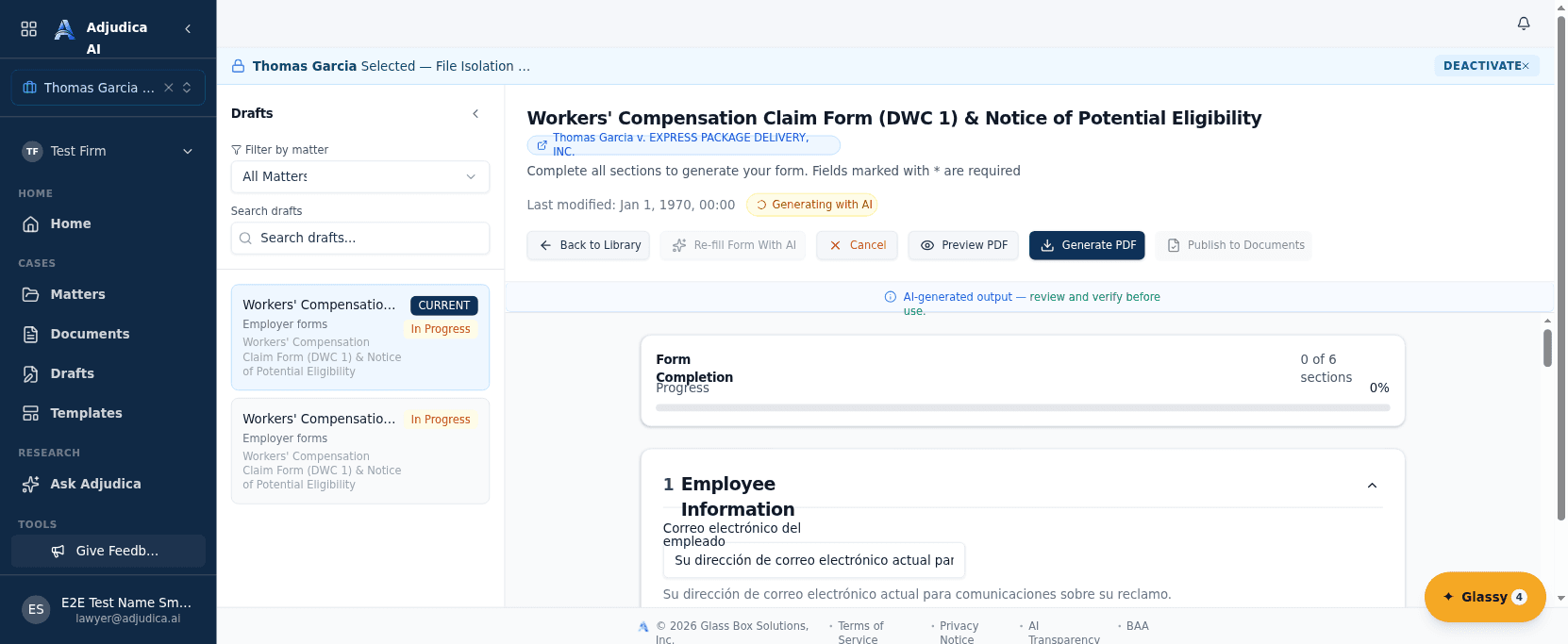
The feature set was informed by CA WC practice. Availability and results depend on the enabled environment, source material, and attorney review.
Assist
Proposed medical-record summaries
Review
Proposed values for supported forms
Draft
Attorney-review document workflows
Verify
Completeness and accuracy against the record
Platform Features
Configured features cover selected document, research, form, timeline, and drafting tasks. Citation and confidence support vary by workflow; no feature guarantees completeness or accuracy.
Upload medical records, QME/AME reports, court filings, and correspondence for configured classification and extraction workflows. Google Document AI is configured for OCR. Classification, OCR, and extracted fields may be incomplete or incorrect and require record review.
Ask questions about processed case material using a configured retrieval workflow. Answers may include page citations where available; counsel must verify the answer, source, and completeness against the record.
Supported California Workers' Compensation forms can receive proposed values from case data. Confidence cues and candidates can assist review, but counsel must verify every proposed or blank field and the rendered filing.
Create proposed drafts from instructions or firm templates. Source links and case values may be included where supported, but names, dates, citations, calculations, legal references, and completeness are not guaranteed. Attorney review is required.
Reuse firm templates with proposed case-specific values. Confidence handling can assist review, but the workflow may propose an incorrect value or omit required content. Verify the complete rendered document before use.
Generate a proposed chronology from processed documents, with source links where available and category labels for review. The timeline may omit, duplicate, or misorder events and is not a complete record without attorney verification.
The configured corpus reports 2,649 CA WC case records, 12,180 extracted principles, 8,152 mapped citations, and 2,685 public-PDF links across 108 years (1918–2026). Corpus counts and AI-extracted material are source-observed, not a guarantee of legal completeness or accuracy.
The configured calculator supports selected Permanent Disability Rating System schedules and can compare entered data with configured materials. Verify inputs, schedule selection, formulas, and results before use; runtime availability was not observed for this release.
See it in the product
The Glass Box Difference
Some Adjudica workflows can attach document-page or legal-source links. Availability, accuracy, and completeness vary, so counsel must inspect the source record and governing authority.
Why It Matters
Licensed counsel remains responsible for professional judgment and review. Available source links and execution context may assist that review but do not establish compliance, understanding, or correctness.
Retrieval and citation checks are configured to reduce unsupported output, but they cannot eliminate fabrication, omission, or citation error. Attorney verification remains required.
When a citation is available, use it as a review aid. Attorneys verify proposed facts, sources, calculations, and legal conclusions against the complete record.
On the Roadmap
Join the early access list to shape these features and be first in line when they launch.
Configured lien workflows can assist with claimant tracking, selected deadline fields, conference preparation, and settlement allocation. Source links may be included where supported, but counsel must verify the lien record, authority, and proposed negotiation summary.
LC 4903 et seq.
Configured workflows can compare utilization-review materials with available MTUS sources and propose issues or IMR petition language. Coverage and citations may be incomplete or wrong; counsel verifies the record, current authority, deadlines, and appeal strategy.
LC 4610; 8 CCR 9792 et seq.